

Self-Handicapping vs. Choking vs. Learned Helplessness in Sports


Why do some athletes, despite their talent, seem to sabotage their own success or crumble under pressure, behaviors often intertwined with their underlying self-esteem? This article will explore three key psychological concepts – self-handicapping, choking, and learned helplessness – and how they can manifest as both a shield against and a consequence of low self-esteem in the competitive sports environment. By understanding these connections, athletes and coaches can better address the root causes of performance issues and foster a healthier sense of self-worth alongside athletic achievement.
Self-Handicapping:
Definition:
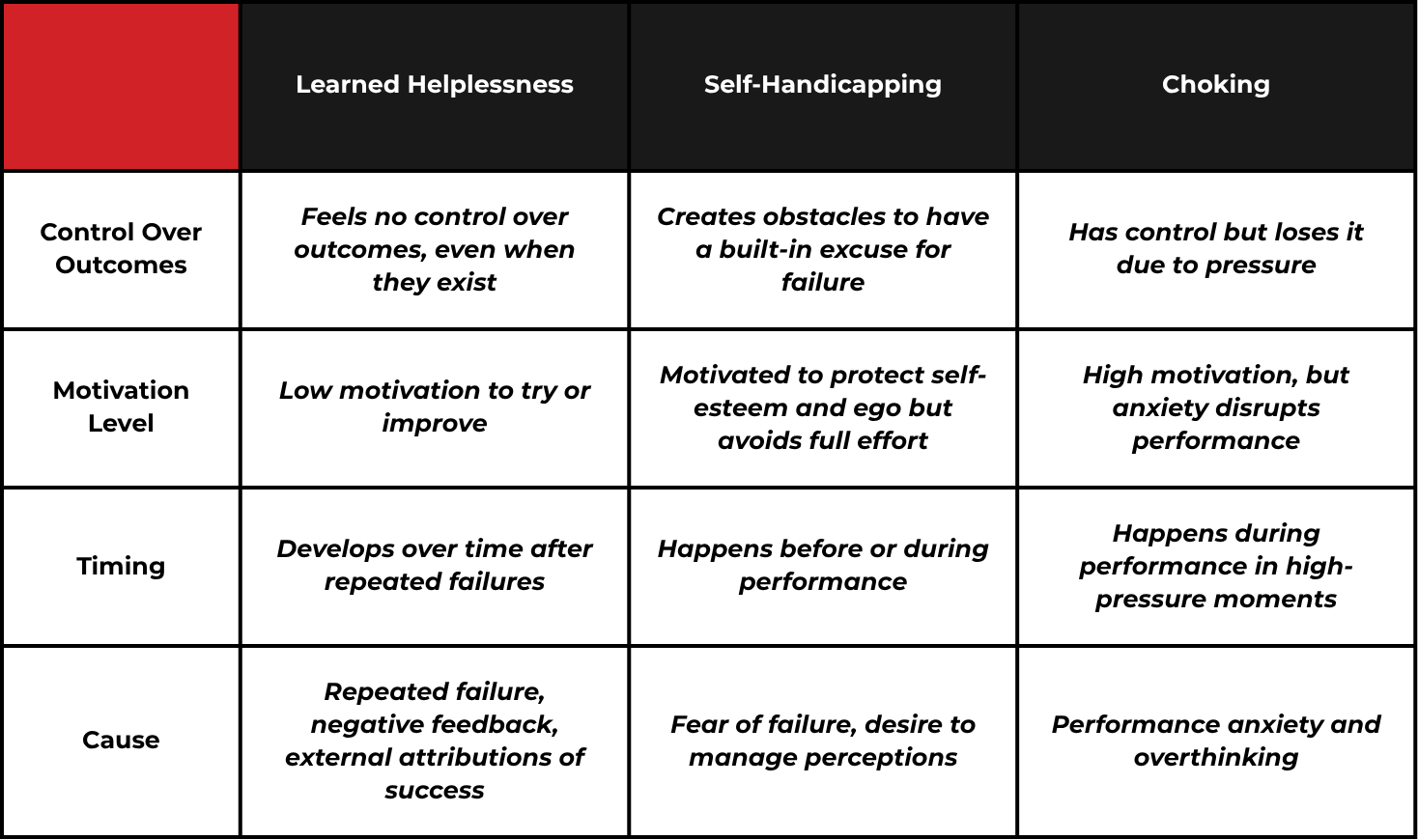
Self-handicapping is when an athlete intentionally creates obstacles or excuses to protect their self-esteem or manage how others perceive them. It’s a proactive behavior—something the athlete does before or during performance to justify or explain potential failure.
Why it Happens:
Self-handicapping stems from a fear of failure and the desire to protect one’s self-image. By creating an external excuse, athletes can avoid internalizing failure as a reflection of their abilities. It’s also a way to manage how others perceive them, as they can attribute failure to external factors rather than lack of skill.
Key Characteristics:
Intentional creation of obstacles (behavioral self-handicapping).
Pre-emptive excuses for failure (verbal self-handicapping).
Protects self-esteem temporarily but undermines long-term performance and growth.
Choking:
Definition:
Choking occurs when an athlete fails to perform under pressure, despite being physically and technically capable of succeeding. It’s an involuntary reaction to high-pressure or high-stakes situations that causes performance to deteriorate.
Why it Happens:
Choking is the result of performance anxiety and overthinking. When the stakes are high, athletes may focus too much on the mechanics of their actions (e.g., how to shoot a basketball) instead of relying on their muscle memory and practiced skills. This overthinking disrupts their automatic performance processes and leads to mistakes.
Key Characteristics:
Happens in high-pressure situations (e.g., finals, match point).
Involuntary; the athlete doesn’t plan or intend to choke.
Linked to anxiety, over-arousal, and fear of negative outcomes.
Often leads to feelings of frustration and self-doubt after the event.
Learned Helplessness:
Definition:
Learned helplessness in sport occurs when an athlete believes they have no control over their performance or outcomes, even when they do. This belief often develops after repeated failures, setbacks, or negative experiences, leading to a sense of resignation and lack of effort.
Why it Happens:
Learned helplessness often stems from negative reinforcement cycles or environments where an athlete experiences repeated failure without success or positive feedback. It can also develop in environments where athletes face:
Unrealistic Expectations: Constantly being compared to others or held to unattainable standards.
External Attribution of Failure: Athletes who believe their failures are due to external factors (e.g., bad luck, biased referees) may feel powerless to change their situation.
Negative Coaching Style: Coaches who focus heavily on criticism without offering constructive solutions can erode an athlete's confidence and sense of agency.
Key Characteristics:
Low Motivation: Athletes no longer put effort into improving because they believe it won’t make a difference.
Negative Self-Talk: Repeated thoughts like "I’m just not good enough" or "What’s the point of trying?"
Avoidance of Challenges: Athletes may avoid situations where they might fail, further limiting opportunities for growth.
Poor Performance: A lack of effort and belief in their abilities leads to underperformance, reinforcing the cycle of helplessness.
How to Address These Phenomena in Sport
1. Overcoming Self-Handicapping:
Focus on Preparation: Commit to practice and preparation, even if there’s a risk of failure.
Adopt a Growth Mindset: View mistakes as opportunities to learn, rather than threats to self-worth.
Set Process-Oriented Goals: Focus on effort and improvement rather than outcomes.
2. Preventing Choking:
Practice Under Pressure: Simulate high-pressure situations during training to desensitize yourself to performance anxiety.
Use Relaxation Techniques: Deep breathing, visualization, or mindfulness can help reduce over-arousal.
Trust Your Training: Focus on automatic responses and avoid overthinking during competition.
3. Addressing Learned Helplessness:
Provide Positive Feedback: Coaches should highlight progress and celebrate small victories to rebuild the athlete’s confidence.
Focus on Controllable Factors: Help athletes identify aspects of their performance they can control (e.g., effort, attitude).
Reframe Failures: Teach athletes to see setbacks as temporary and specific, rather than permanent and pervasive.
Conclusion
While self-handicapping, choking, and learned helplessness are all challenges athletes may face, they are distinct in their causes and effects. Understanding these phenomena can help athletes, coaches, and teams develop targeted strategies to overcome them. By fostering a growth mindset, building confidence, and focusing on preparation and effort, athletes can minimize the impact of these psychological barriers and unlock their full potential.
Want more from The MENTOR Magazine? Unlock the full archive of mental performance knowledge today:


References:
Bandalos, D. L. (2018). Self-handicapping and academic performance: A review of the literature. Educational Psychology Review, 30(1), 1-25.
Burton, D. (2010). Choking in sport: A review of the literature. International Journal of Sports Science & Coaching, 5(2), 219-228.
Dweck, C. S. (2006). Mindset: The new psychology of success. Random House.
Maier, S. F., & Seligman, M. E. P. (1976). Learned helplessness: Theory and evidence. Journal of Experimental Psychology: General, 105(1), 3-46.
Prapavessis, H., & Grove, J. R. (1998). Self-handicapping and self-esteem. Journal of Applied Sport Psychology, 10(2), 175–184.
Weinberg, R. S., & Gould, D. (2018). Foundations of sport and exercise psychology (7th ed.). Human Kinetics.